

The Library Program
Discover our collection of creative activities and fun hands on projects taking place at the Abington Public Library. Each section mainly includes details of past events, the informative mini lesson, and photos from the club meeting.
pH and Acid/Base Identification - 10/22/26
Report coming soon!

Mini-Lesson (updates coming soon)


Strawberry DNA Extraction - 09/08/26
This meeting started off with our typical mini-lesson exploring DNA, DNA structure, and chromosomes! We learned DNA's role in the body and about its shape and structure: similar to a twisting ladder! We talked about the nucleotides that make up the 'steps' of the DNA ladder and how groups of nucleotides make up genes; genes can determine hair type, nose shape, eye color, and so much more! Then, we learned about chromosomes and how humans have two copies of each chromosome while strawberries have eight copies! We wrapped up the lesson by talking about the 23rd chromosome and its role in determining your biological sex.
After learning, we passed out materials to start our activity. We used strawberries, ziplock bags, dish soap, salt, water, rubbing alcohol, coffee filter, plastic cups, and popsicle sticks. We demonstrated while the children worked in pairs and followed along; smushing the strawberries was a lot of fun! Our new team of volunteers in addition to our volunteer board assisted the children to mix together materials and filter their mixture. We extracted lots of gloopy DNA!

Mini-Lesson


Borax Crystals - 08/17/26
This meeting started off with our typical mini-lesson exploring crystallization and states of matter. We learned about the process of crystallization and how molecules stack up in a neat and organized order. Then, we learned about the three states of matter: solid, liquid, and gas. We even did a dance to represent molecules at each state! Afterwards, we talked about how cooling a supersaturated solution after boiling can create crystals. The molecules move closer together leaving less space for the solute. This causes the solute molecules to stack up and form crystals!
After learning, we passed out materials to start our activity. We used pipe cleaners, jars, masking tape, borax, and string/ribbon. We passed out instructions on how to complete the activity. Hot water needed to be added at home to ensure safety for everyone. Volunteers assisted the children to tie their pipe cleaner designs to the jar lid and make sure their jars were ready to complete at home!

Mini-Lesson


Balloon Powered Cars - 07/20/26
This meeting started off with our typical mini-lesson exploring different kinds of energy. We learned about potential energy which is stored energy is waiting to be released. Then, we learned about kinetic energy, the energy of motion in which energy is released. We discussed examples of both kinds of energy and learned the differences. Additionally. We learned about Issac Newton, and his three laws of motion. 1. Inertia: Objects are lazy! They don't move unless a force in put on them. 2. Acceleration: Larger things need more force to move then smaller things. 3. Action/Reaction: Forces are never lonely! They always come in pairs when two objects interact. There is an equal push and pull for each object. Lastly, we learned that energy is never created nor destroyed! It can change in presentation, but the amount in the universe is always the same.
After learning, we passed out materials to start our activity. We used toilet paper rolls, straws, bottle caps, lollipop sticks, hot glue, and a hole puncher. We passed out magnetic wands to show students how the magnetic slime is attracted to the magnet. Volunteers and adults handled hot glue to ensure safety. The children got to keep to race their cars and 'blow' us away with their car designs!

Mini-Lesson


Magnetic Slime - 06/23/26
This meeting started off with our typical mini-lesson applying scientific concepts to magnets. We learned about magnetism, the force that makes magnets stick to magnetic objects. We investigated how forces can cause a push or a pull. Another things we covered were magnetic fields, areas around magnets that have a magnetic force. Some metals are more magnetic than others such as nickel, iron, and cobalt which are found in everyday objects. Lastly, we applied the aspects of magnetism and magnets to Earth, as Earth is in a sense a large rotating magnet. Our planet has North and South poles, a magnetic metal core, and gravity acts as a magnetic force, pulling all objects to Earth.
After learning, we passed out materials to start our activity. We used transparent school glue, contact lens solution, baking soda, and iron filings which were individually separated and measured out to make the activity easy and organized for the children. We passed out magnetic wands to show students how the magnetic slime is attracted to the magnet. The children got to keep the slime and take it home to continue playing and exploring!

Mini-Lesson


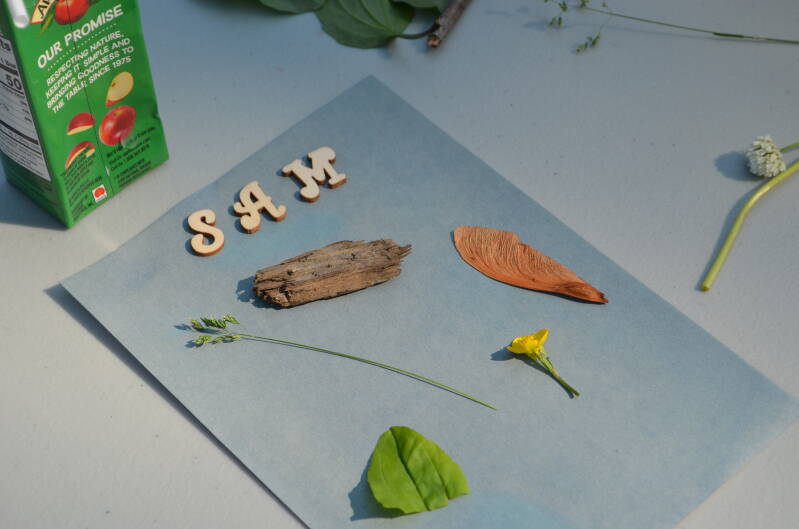
Cyanotype Paper and NatureWalk - 05/18/26
This meeting started off with our typical mini-lesson explaining how cyanotype printing works. We explained the science behind "sun art" and how sunlight creates patterns on cyanotype paper. We learned that cyanotype paper is coated in a chemical iron salt solution that turns dark blue when exposed to sunlight. Thus, areas of the paper that are covered by objects will be shielded from the sunlight and remain white.
After learning, we went outside to start our activity. We went on a nature walk outside to collect sticks, flowers, grass, leaves, pinecones, and whatever else the children wanted to use to create their sun art. Next, we gathered at tables in the sun to arrange our art by arranging objects on the paper, then letting them sit out in direct sunlight for about five minutes. Then, we dunked our cyanotype paper into cool water and kept it submerged for about five to ten minutes. We then pulled out the paper and revealed our sun art masterpieces!

Mini-Lesson



Glowing Spinach - 04/20/26
This meeting started off with our typical mini-lesson explaining what chlorophyll is. We then explored how chloroplasts within chlorophyll helps plants make food for themselves, in a process called photosynthesis. We then learned a unique fun fact; chlorophyll is fluorescent under ultraviolet light! Natural chlorophyll dye produces a glow under UV light that is unlike artificial dye.
After learning we started our activity; making spinach glow under UV light. We started by squishing spinach in a plastic bag to form a paste using our fingers and rolling pins. Then, we added a few pumps of hand sanitizer. Alcohol and chlorophyll molecules are both lipophilic, or oil loving, so alcohol is best for extracting chlorophyll from spinach. We mixed the hand sanitizer and spinach together and then extracted the liquid. As a control, we compared the glasses of chlorophyll liquid to cups of water with green food coloring. Under the UV light, the glasses with chlorophyll glowed while the dyed water did not. This demonstrated how chlorophyll is fluorescent under UV light!

Mini-Lesson

Stay Updated
Don't miss out on the chance to explore our website to see what kinds of amazing opportunities you children could participate in! We always have something fun planned so make sure to tune in every month!
Create Your Own Website With Webador